
How many casino tables does 100 guests need? One blackjack table covers 20 to 25 people, one craps table covers 75 to 100, and every table wants about 100 square feet. Here is how to turn that into a floor plan.

How Many Casino Tables You Need for Your Headcount
By Jeff Durocher, Owner, US Poker & Casino Parties
It is the first question on nearly every call. You have a headcount, a room and a budget, and you want to know how many tables that buys you before anyone talks price.
The ratios are simple. The part people get wrong is what happens after you apply them, because a casino floor sized straight off the guest list is almost always too many tables in too little room. Here is how to work out a casino table rental that fits both the headcount and the floor.
The short answer
Two numbers do most of the work.
- Blackjack: one table per 20 to 25 guests.
- Craps: one table per 75 to 100 guests.
For 100 guests that reads as four or five blackjack tables and one craps table. Keep reading before you book six, because the real number is lower and the reason is the interesting part.
Blackjack carries the floor
Blackjack is where most of your guests end up, which is why its ratio is the tightest. A hand takes 20 to 30 seconds, so a full table runs 400 to 500 hands across a four-hour event. People cycle through fast, and nobody waits long for a seat.
That turnover is what makes the 20-to-25 figure work. It assumes a steady queue rather than everyone seated at once. If blackjack is the only game you are running, hold to the ratio. If it shares the floor with craps and a wheel, you can come down a table and nobody notices.
A blackjack table rental comes with a professional dealer, which also sets a practical ceiling: tables you cannot staff are tables you do not want.
Craps needs one table and a lot of room
Craps is the opposite shape. One table covers 75 to 100 guests, because it gathers a crowd instead of a queue. A craps table runs about 12 feet by 5 feet including the rail and holds 12 to 16 players along the sides, with a ring of people watching behind them.
[EDITOR: the live FAQ page says up to 12 active bettors at the rail. The task brief says 12 to 16. Reconcile the two before publishing and make the site and the post agree.]
That crowd is the point. A craps table is the loudest thing in the room and it pulls people who were not planning to play. One is usually enough. A second rarely earns its footprint until you are well past 150 guests.
Worth knowing when you plan: craps takes two dealers per table, so inventory is tighter than it is for the other games. Book it earlier than the rest.
Poker and roulette: ask rather than assume
There is no clean guests-per-table figure for poker or roulette, and publishing one would be guesswork.
Both depend on format. A poker tournament is sized by seats and structure, not by headcount: a single-table sit-and-go runs 90 to 120 minutes and a multi-table event runs three to four hours, so the table count follows the bracket you want. Roulette sits somewhere between blackjack and craps, with a spin cycle of 60 to 90 seconds and 120 to 180 spins over a four-hour night, and it draws a standing crowd the way craps does.
For either one, the table count comes out of a conversation about what you want the night to feel like. Ask for a quote and say how long you want the tournament to run.
Floor space is the constraint people miss
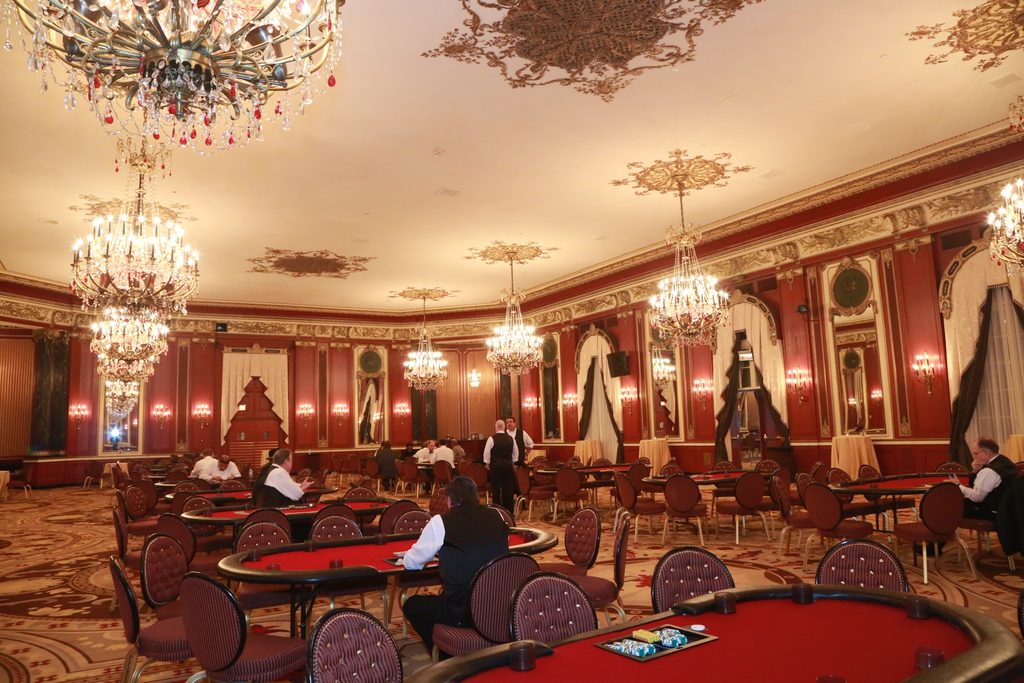
Here is the number that changes plans: about 100 square feet per gaming table, plus walking room.
That is not just the table. It is the dealer’s side, the players’ side, the chairs pushed back, and enough room behind for people to stand and watch without blocking the route to the bar. Six tables is roughly 600 square feet of gaming footprint before you add circulation, and circulation is what makes a casino floor feel like a party rather than a queue.
A useful benchmark: a ballroom that seats 200 for dinner comfortably hosts a six-table casino floor. If your room seats fewer than that for dinner, size down rather than squeezing in another table.
Not everyone plays at once
This is the correction that saves most planners two tables and a chunk of budget.
At any moment during a casino night, a good share of your guests are at the bar, eating, talking, taking photos or watching somebody else’s hand. The per-game ratios describe peak demand. They assume the whole room wants a seat at the same minute, and the whole room never does.
So the 200-guest arithmetic that says eight to ten blackjack tables is a ceiling, not a plan. Six tables in a 200-person ballroom keeps every table busy, keeps the room walkable and keeps the energy up. A floor that is 40 percent empty looks like a failed party even when the headcount is right.
Three worked examples
60 guests
Two to three blackjack tables. No craps at this size: one table covers 75 to 100 people and 60 does not fill it. Add a wheel or a specialty game if you want variety. Roughly 300 square feet of table footprint plus circulation.
100 guests
Three to four blackjack tables and one craps table. That is the classic corporate build, and it is the configuration most people picture when they imagine a casino night. Roughly 500 square feet of table footprint plus circulation.
200 guests
About six tables in total, weighted toward blackjack with one craps table at the centre of the room. Put craps where the noise helps rather than against a back wall. Roughly 600 square feet of table footprint plus circulation.
What the tables are actually for
One thing to settle early with your group: nobody is playing for money. Every table runs on play chips. Guests get free chips at the start, play through the night, and exchange what they have left for raffle tickets or prizes you provide. That structure is what keeps a private event clear of Illinois gaming rules, which the Illinois Gaming Board enforces for licensed commercial gambling. Fundraisers that want real-money play fall under the Illinois Charitable Games Act and need licensing well in advance, so build the night around prizes instead unless you have already gone through that process.
It also changes the table math slightly in your favour. Play-chip tables turn over faster than real ones, because nobody is protecting a stack.
Frequently Asked Questions
Q: How many blackjack tables do I need for 100 guests?
Four to five, if blackjack is the only game. One blackjack table serves 20 to 25 guests. On a mixed floor with craps and other games running alongside it, three is usually enough.
Q: How many guests does one craps table cover?
One craps table covers 75 to 100 guests. It draws a crowd rather than a queue, so a second table rarely earns its footprint until you are well past 150.
Q: How much floor space does a casino table need?
Roughly 100 square feet per gaming table, plus walking room between them. A ballroom that seats 200 for dinner comfortably hosts a six-table casino floor.
Q: How many tables does a 200-guest event need?
About six. The per-game ratios are a ceiling that assumes everyone plays at once, and they never do. A six-table floor in a 200-person ballroom keeps every table busy without the room feeling crowded.
Q: Do guests play for real money?
No. Every table runs on play chips. Guests get free chips at the start, play through the night, and exchange what they have left for raffle tickets or prizes the host provides.
Q: How far ahead should I book a casino table rental?
Six to eight weeks in peak season, which runs October to December. Craps inventory is tighter than the rest because each table needs two dealers.
Get the Floor Plan Right
Send us your headcount and your room dimensions and we will tell you what fits, including where to put the craps table so the noise works for you. If you want the wider picture first, what a casino party rental actually includes covers the rest of the build, and the FAQ page answers the per-game questions. When you are ready, ask for a quote.
Join Our Players Club
Subscribe to our Players Club Newsletter for promotions, updates, event inspiration, and industry insights. Stay connected and be the first to know about new offerings and special deals.
Contact Us
Connect With Us


Copyright © 2014-2026 · US Poker & Casino Parties · All Rights Reserved.